CAMS: How Campus Management Software Is Transforming Educational Institutions
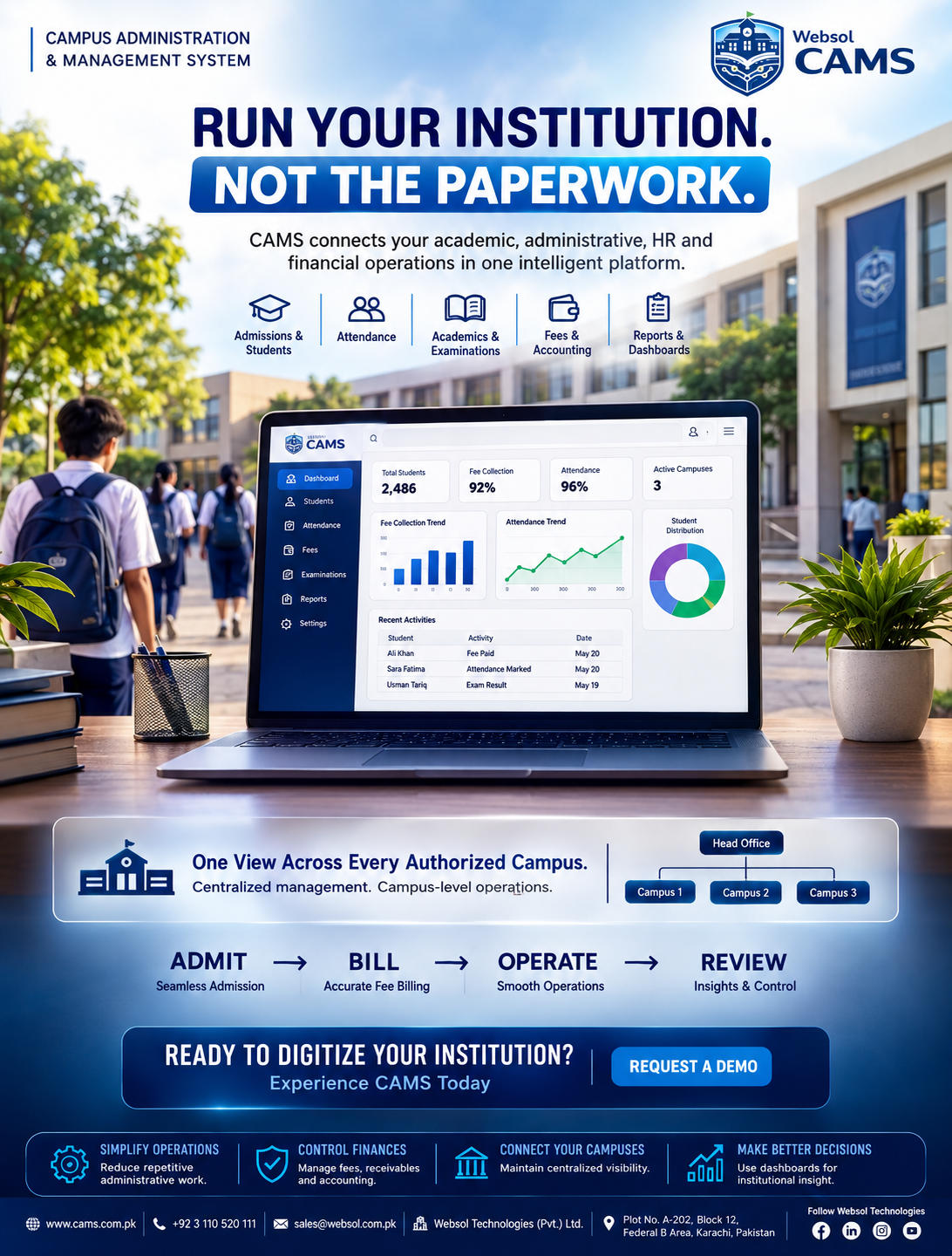
CAMS: How Campus Management Software Is Transforming Educational Institutions
Introduction: The Changing Education Landscape
The education sector is evolving rapidly. Schools, colleges, academies, and other educational institutions are no longer managing only classrooms and academic activities. They must also handle student admissions, attendance, examinations, fee collection, teacher records, timetables, parent communication, administrative documentation, and institutional reporting.
As the number of students and operational activities increases, managing everything manually can become complicated and time-consuming. Paper-based records, spreadsheets, disconnected systems, and manual communication processes can create unnecessary workload for administrators and staff. They may also increase the chances of human errors, duplicate records, delayed information, and difficulty accessing important data when it is needed.
This is where a Campus Administration and Management System (CAMS) can play an important role.
A modern Campus Management System helps educational institutions bring their major academic and administrative operations together into a centralized digital environment. Instead of managing information across multiple files, registers, spreadsheets, and departments, institutions can use a single integrated platform to organize operations more efficiently.
For educational institutions in Pakistan, digital transformation is becoming increasingly important. As schools, colleges, academies, and multi-campus organizations grow, the need for better coordination, faster access to information, and efficient administration becomes even greater.
CAMS – Campus Administration and Management System by Websol Technologies (Pvt.) Ltd. is designed to support this transformation by helping educational institutions move toward a more organized, connected, and digitally managed environment.
What Is a Campus Administration and Management System (CAMS)?
A Campus Administration and Management System, commonly known as CAMS, is a software solution designed to help educational institutions manage their academic, administrative, and operational activities through a centralized platform.
In simple terms, CAMS acts as a digital management system for an educational institution.
Instead of maintaining separate records for admissions, students, attendance, fees, examinations, teachers, and other activities, relevant information can be organized and managed within one system.
A well-designed Education Management Software solution can help different departments work with better coordination. For example, the administration department may manage admissions and student information, the accounts department may monitor fees and financial records, while academic departments can manage attendance, examinations, and student performance.
Because information is organized centrally, authorized users can access relevant data more quickly and efficiently.
This makes CAMS more than just a digital record-keeping system. It can become an important part of an institution's overall operational structure.
Common Challenges Faced by Educational Institutions
Educational institutions deal with a large amount of information every day. When this information is managed manually, several operational challenges can arise.
Manual Student Record Management
Maintaining student information through physical files or separate spreadsheets can be difficult to manage, particularly as student numbers increase.
Finding a specific student's information may take time, while updating records across multiple files can increase the possibility of duplicating or inconsistent data.
A centralized Student Management System can help institutions organize student records in a more structured and accessible way.
Time-Consuming Attendance Processes
Traditional attendance registers require teachers and administrators to record, compile, and review information manually.
When attendance information needs to be shared with parents or analyzed for administrative purposes, additional effort may be required.
Digital attendance management can make this process more organized and provide quicker access to attendance information.
Complex Fee Collection and Tracking
Fee management is one of the most important administrative responsibilities for schools, colleges, and academies.
Tracking payments, outstanding balances, receipts, concessions, and financial records manually can become challenging. As the institution grows, the administrative workload also increases.
A centralized system can help organize fee-related information and make financial tracking easier.
Examination and Result Management
Managing examinations involves multiple processes, including student records, subject information, marks, grades, and result preparation.
Manual processes can take significant time and may create opportunities for calculation or data-entry errors.
A digital system can help institutions organize examination-related information and simplify result management.
Communication Gaps
Effective communication between the administration, teachers, students, and parents is essential for a smooth educational experience.
When communication depends entirely on manual notices, phone calls, or disconnected channels, important information may be delayed or missed.
A centralized Campus Administration System can support more organized communication and information sharing.
Paper-Based Documentation
Educational institutions generate a significant amount of documentation.
Admissions, student records, fee receipts, attendance registers, examination records, staff information, and administrative documents can create a large paper trail.
Reducing unnecessary paperwork through digital processes can improve accessibility and make information easier to organize.
Difficulty Managing Multiple Campuses
Multi-campus institutions face an additional level of complexity.
Managing information separately for each campus can make it difficult for management to maintain a complete view of institutional operations.
A Multi-Campus Management System can help centralize information and provide better visibility across different locations.
Limited Access to Real-Time Information
Decision-makers need accurate information to understand what is happening across their institution.
If reports depend on manually collecting information from multiple departments, the process can be slow.
A digital management platform can help generate organized reports and provide management with quicker access to relevant operational information.
How CAMS Simplifies Educational Management
A comprehensive CAMS Software solution can bring multiple institutional activities together under one centralized system.
Student Admissions and Registrations
The student journey begins with admission and registration.
CAMS can help institutions organize applicant and student information digitally, reducing dependency on scattered forms and files. This creates a more structured foundation for managing student records throughout their academic journey.
Student Information and Academic Records
Student profiles can include important information such as academic details, enrollment information, class assignments, and other relevant records.
Instead of searching through physical files or multiple spreadsheets, authorized staff can access information through a centralized system.
Attendance Management
Attendance is a routine but important academic activity.
A digital attendance management process can help institutions record, organize, and review attendance information more efficiently. This can also make it easier for administrators to monitor attendance patterns and generate relevant reports.
Fee Collection and Financial Records
A School ERP Software or campus management platform can support more organized fee management.
Institutions can manage fee structures, payment records, outstanding balances, and related financial information in a structured environment. This can reduce manual effort and improve visibility for authorized administrative and accounts teams.
Examination and Result Management
CAMS can help organize examination-related activities by managing student information, subjects, marks, grades, and results.
By centralizing this information, institutions can simplify the process of preparing and managing academic records.
Teacher and Staff Management
Educational institutions also need to manage information related to teachers and staff.
A centralized platform can help organize staff records and relevant administrative information, reducing the need to maintain disconnected files across different departments.
Timetable and Class Management
Coordinating classes, subjects, teachers, and schedules can become increasingly complex as an institution grows.
A digital system can help organize timetable and class-related information, making coordination easier for academic and administrative teams.
Communication and Information Sharing
Better communication can improve the overall experience for students, parents, teachers, and administrators.
A centralized Educational Institution Management Software solution can support structured information sharing and reduce communication gaps between different stakeholders.
Reports and Analytics
Data is most useful when it can support better decision-making.
CAMS can help institutions organize information into reports that provide insights into different areas of operations. Management can use relevant reports to monitor activities, identify trends, and make more informed decisions.
Multi-Campus Operations
For organizations operating multiple branches or campuses, centralized management can be especially valuable.
Instead of treating every campus as an isolated operation, a unified system can provide greater visibility and coordination across the organization.
Key Benefits of CAMS for Educational Institutions
Implementing a Campus Management System can provide benefits across different areas of an educational institution.
Reduced Administrative Workload
Automation can reduce the time spent on repetitive administrative activities.
Instead of repeatedly entering, collecting, and compiling information manually, staff can work with organized digital processes.
This allows administrative teams to focus more on productive and value-driven responsibilities.
Reduced Paperwork and Human Errors
Manual data entry and paper-based documentation can increase the risk of misplaced files, duplicate information, and errors.
Centralized digital records can help institutions maintain more organized information and reduce dependency on manual processes.
Faster Access to Information
When information is stored across different files and departments, retrieving it can take time.
With a centralized system, authorized users can access relevant information more quickly.
Improved Operational Efficiency
When departments work through disconnected processes, coordination can become difficult.
An integrated system can help connect different operational areas and improve the overall flow of information.
Better Communication and Transparency
Students, parents, teachers, administrators, and management all depend on accurate information.
A structured digital environment can improve the consistency and accessibility of institutional information.
Centralized and Organized Data
One of the most important advantages of CAMS is centralized data management.
Instead of maintaining separate databases and files for different functions, institutions can organize important information within a connected system.
Improved Decision-Making
Educational leaders need access to accurate information when making operational and strategic decisions.
Reports and analytics can provide management with better visibility into institutional activities and performance.
Scalability for Growing Institutions
As student numbers, staff, campuses, and administrative responsibilities increase, manual processes can become more difficult to manage.
A scalable Education Management Software solution can support institutions as their operational requirements grow.
Better Experience for Stakeholders
Efficient systems can benefit everyone involved in the educational environment.
- Students can experience more organized academic processes.
- Parents can receive better access to relevant information and communication.
- Teachers can spend less time on repetitive administrative activities.
- Administrators can manage information more efficiently.
- Management can gain better visibility across institutional operations.
CAMS for Schools, Colleges, Academies, and Multi-Campus Institutions
Different educational institutions have different operational requirements. However, they all need accurate information, efficient processes, and effective coordination.
CAMS for Schools
Schools manage many routine activities, including student admissions, attendance, academic records, examinations, fees, and parent communication.
A School Management Software in Pakistan can help bring these activities into a more organized digital environment.
For example, school administration can monitor student attendance while maintaining organized academic and administrative records through a centralized system.
CAMS for Colleges
Colleges often manage larger student populations, multiple departments, courses, faculty members, and examination processes.
A College Management System can help organize student records, academic information, fee management, examinations, and departmental operations.
This can reduce the complexity associated with managing multiple disconnected processes.
CAMS for Academies and Training Institutes
Academies and training centers also require efficient management of admissions, students, classes, attendance, fees, and academic performance.
A centralized system can help academy owners and administrators organize these operations and maintain better control as their institution grows.
CAMS for Multi-Campus Organizations
Managing multiple campuses requires coordination at both the campus and organizational levels.
A centralized Multi-Campus Management System can help management monitor operations across different locations while maintaining structured access to relevant institutional information.
For growing educational organizations, this centralized approach can support better coordination and operational visibility.
The Role of Automation in Modern Education
Automation is becoming increasingly important across many industries, including education.
Educational professionals should be able to focus their time and expertise on activities that create the greatest value. Teachers can focus more on teaching and student development, while administrators can concentrate on improving institutional processes.
However, repetitive tasks such as manually compiling attendance, organizing records, preparing reports, and managing routine administrative information can consume significant time.
Automation can help reduce this burden.
For example, instead of manually collecting information from different departments to prepare a report, relevant data can be organized within a centralized system. Similarly, routine processes related to records, attendance, fees, and academic management can become more structured.
The goal is not simply to replace existing processes with technology. The goal is to create smarter and more efficient ways of managing educational operations.
Why Digital Transformation Is Important for the Education Sector
Digital transformation is no longer limited to large corporations and technology companies.
Educational institutions also need systems that can support increasing operational demands.
As institutions grow, manual processes may become more difficult to maintain. More students mean more records. More campuses mean greater coordination requirements. More departments mean a larger volume of information.
Digital campus management can help address these challenges.
Efficiency
Digital processes can reduce repetitive manual work and improve the speed of routine administrative activities.
Accuracy
Centralized information can help reduce problems associated with duplicate records and inconsistent data.
Accessibility
Authorized users can access relevant information more efficiently when data is properly organized within a centralized system.
Scalability
Digital systems can support institutions as they expand their student base, departments, programs, and campuses.
Data-Driven Decision-Making
Accurate reports and organized information can help management make decisions based on actual operational data.
Improved Stakeholder Experience
A well-managed digital environment can create a smoother experience for students, parents, teachers, administrative staff, and institutional leadership.
Digital transformation is therefore not simply about using software. It is about improving the way an educational institution operates.
How Websol CAMS Supports Digital Campus Management
CAMS – Campus Administration and Management System by Websol Technologies (Pvt.) Ltd. is designed to support educational institutions in managing their operations through a centralized digital platform.
The objective is simple:
ONE CAMPUS. ONE SYSTEM. COMPLETE CONTROL.
Educational institutions often operate through multiple departments, each responsible for different activities. When these departments rely on disconnected records and manual processes, it can become difficult to maintain visibility and coordination.
An integrated campus management approach can help bring important operational areas together.
From student administration and academic activities to attendance, fees, examinations, staff information, reporting, and multi-campus coordination, a centralized system can provide institutions with a more organized way to manage their operations.
For schools, colleges, academies, institutes, and growing educational organizations, CAMS can support the transition toward a more efficient and digitally connected campus environment.
The value of a modern Campus Administration System lies not only in digitizing individual tasks but also in creating better connections between institutional processes.
When information is organized, accessible, and managed through a unified platform, educational leaders can gain better visibility and greater control over daily operations.
Building the Digital Campus of the Future
The future of educational management will increasingly depend on the ability of institutions to manage information efficiently.
Students expect smoother experiences. Parents expect better communication. Teachers need tools that reduce unnecessary administrative workload. Management requires accurate information to support institutional planning and growth.
A modern CAMS Software solution can help bring these requirements together.
The transition from paper-based and disconnected processes toward a centralized digital environment does not happen simply by installing software. It requires institutions to rethink how they manage information and operations.
However, the right technology can provide a strong foundation for this transformation.
By digitizing important processes, centralizing institutional data, and improving coordination between departments, educational organizations can build a more efficient operational structure for the future.
Conclusion
Managing a modern educational institution involves much more than managing classrooms and academic schedules. Schools, colleges, academies, and multi-campus organizations must coordinate a wide range of administrative and academic activities every day.
Manual and disconnected processes can make these responsibilities increasingly difficult as an institution grows.
A Campus Management System provides a more structured approach by helping institutions centralize information, streamline operations, reduce paperwork, improve communication, and support better decision-making.
From student admissions and attendance to fees, examinations, staff management, reporting, and multi-campus operations, an integrated platform can help create a more connected educational environment.
CAMS – Campus Administration and Management System by Websol Technologies (Pvt.) Ltd. offers a modern approach to digital campus management for educational institutions looking to improve efficiency, organization, and operational control.
ONE CAMPUS. ONE SYSTEM. COMPLETE CONTROL.
If your school, college, academy, institute, or multi-campus organization is ready to move toward a more organized and digitally connected future, explore how CAMS can support your institution's digital transformation and simplify the way you manage education.
Author Details

Related Posts

7 Sep,2026
Bawarchi POS: Smart Restaurant Management Software
Bawarchi POS: How Smart Restaurant Management Software Can Transform Your Food Business
Running a restaurant is much more than serving...
31 Aug,2026
Muhasib ERP | Complete Business Management Software in Pakistan
Muhasib ERP: Complete Business Management Solution with Smart Automation and Advanced Features
Running a business becomes increasingly...